Back from the Brink
by Ryan Masters, June 21, 2026
On a rainy Friday morning in April, I carry two five-gallon plastic buckets down a muddy forest trail.
The way is slippery and, in places, steep and littered with exposed roots.
I watch my step, keenly aware of my fragile burden.
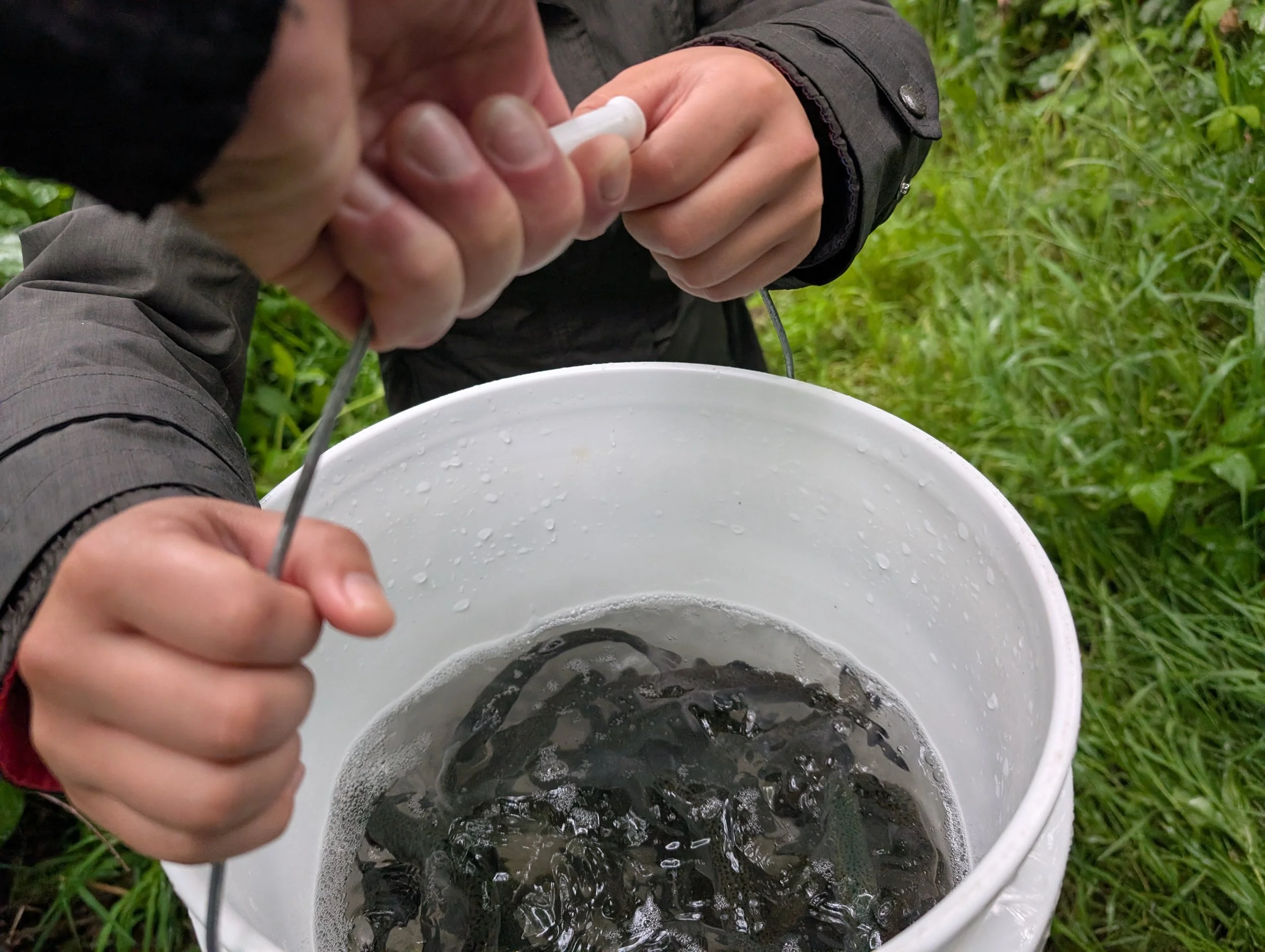
Within the water of each bucket writhe 30 or so young coho salmon. These bright, silvery smolt are roughly 1 year old. Their greenishblue backs glisten in the buckets like gems. White-tipped fins and black-spotted upper tail lobes froth the water, threatening to spill over the bucket’s lip.
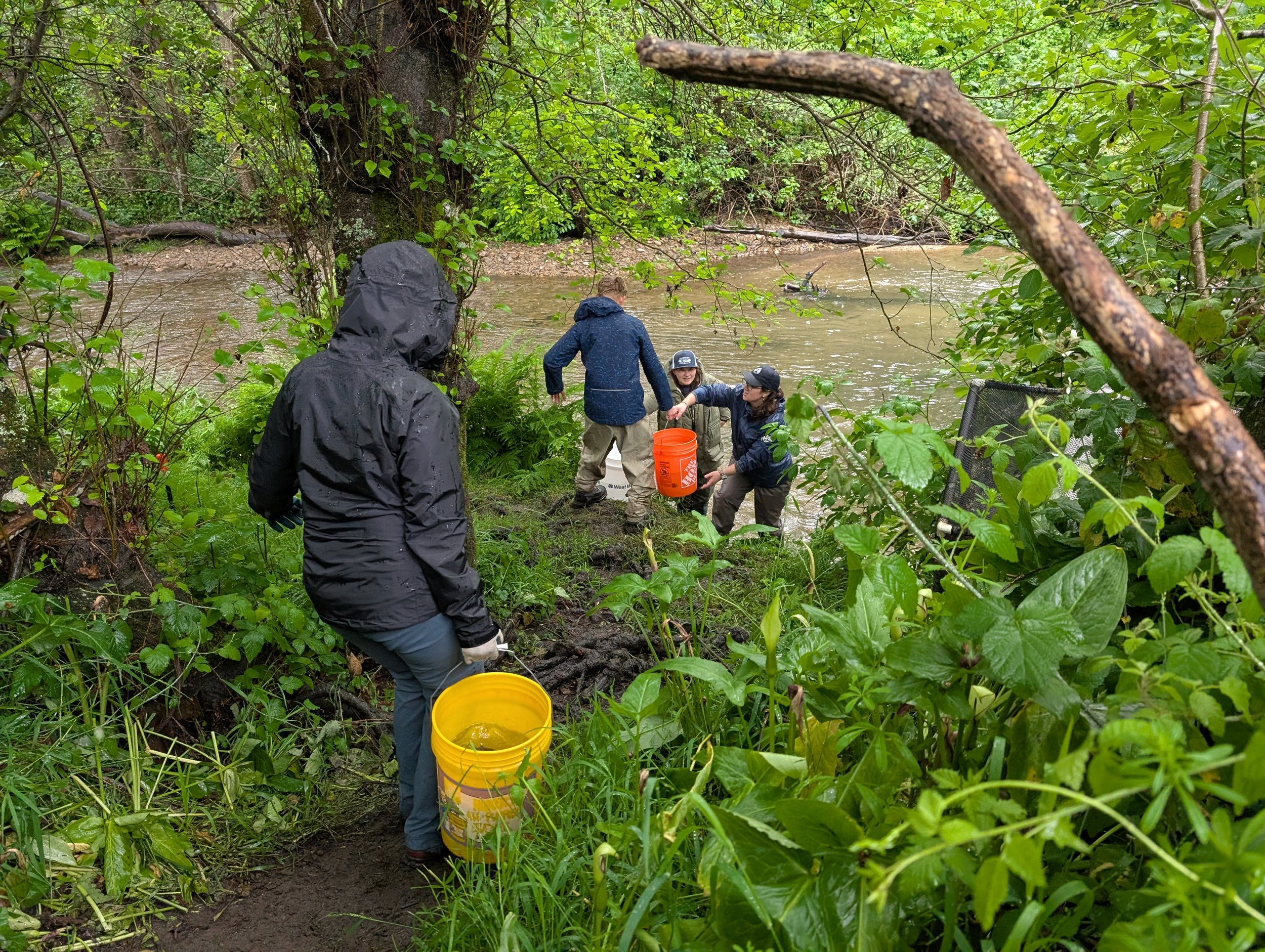
Biceps burning, I pick my way down the final section of trail to the bank of Scott Creek and carefully hand the buckets off to a Watershed Stewards Program corps member with the National Oceanic and Atmospheric Administration (NOAA).
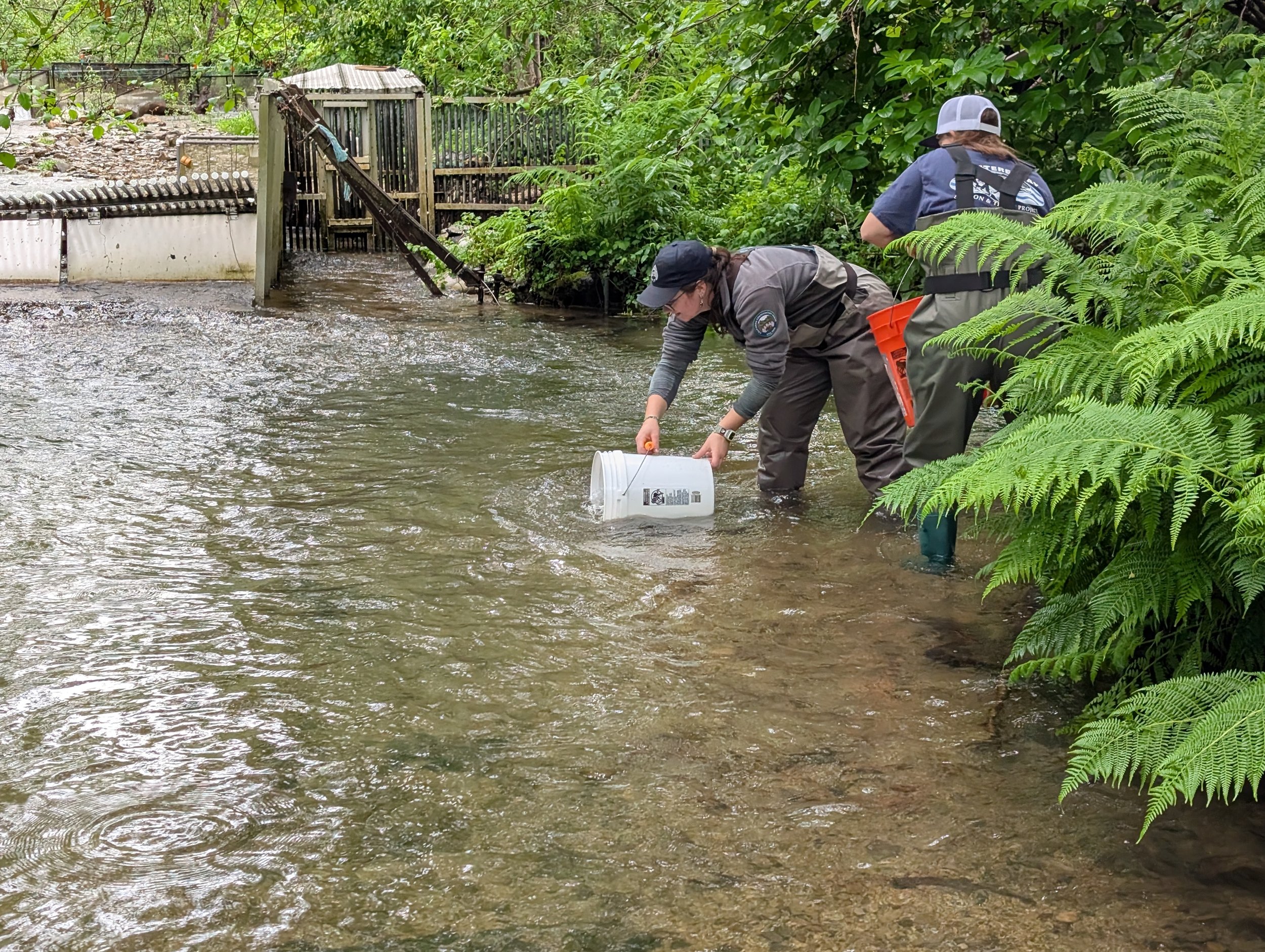
One at a time, she dips the buckets into the clear water of the creek and, in a flash, the fish are gone, darting instinctively downstream toward the lagoon. In 24 hours or so, they’ll be swimming in the Pacific Ocean.
The corps member hands the buckets back and I return the way I came on the trail, emerging from the forest and onto a dirt road beside Cal Poly’s Swanton Pacific Ranch.
I approach a white pickup truck and hand the buckets up to Connor Greenwood of the Monterey Bay Salmon and Trout Project (MBSTP), which honors its 50th year on Aug. 1 in Watsonville.
Dressed in brown waders and balanced in the bed of the truck, Greenwood leans over a large water tank full of fish and checks dissolved oxygen levels with a short plastic wand.
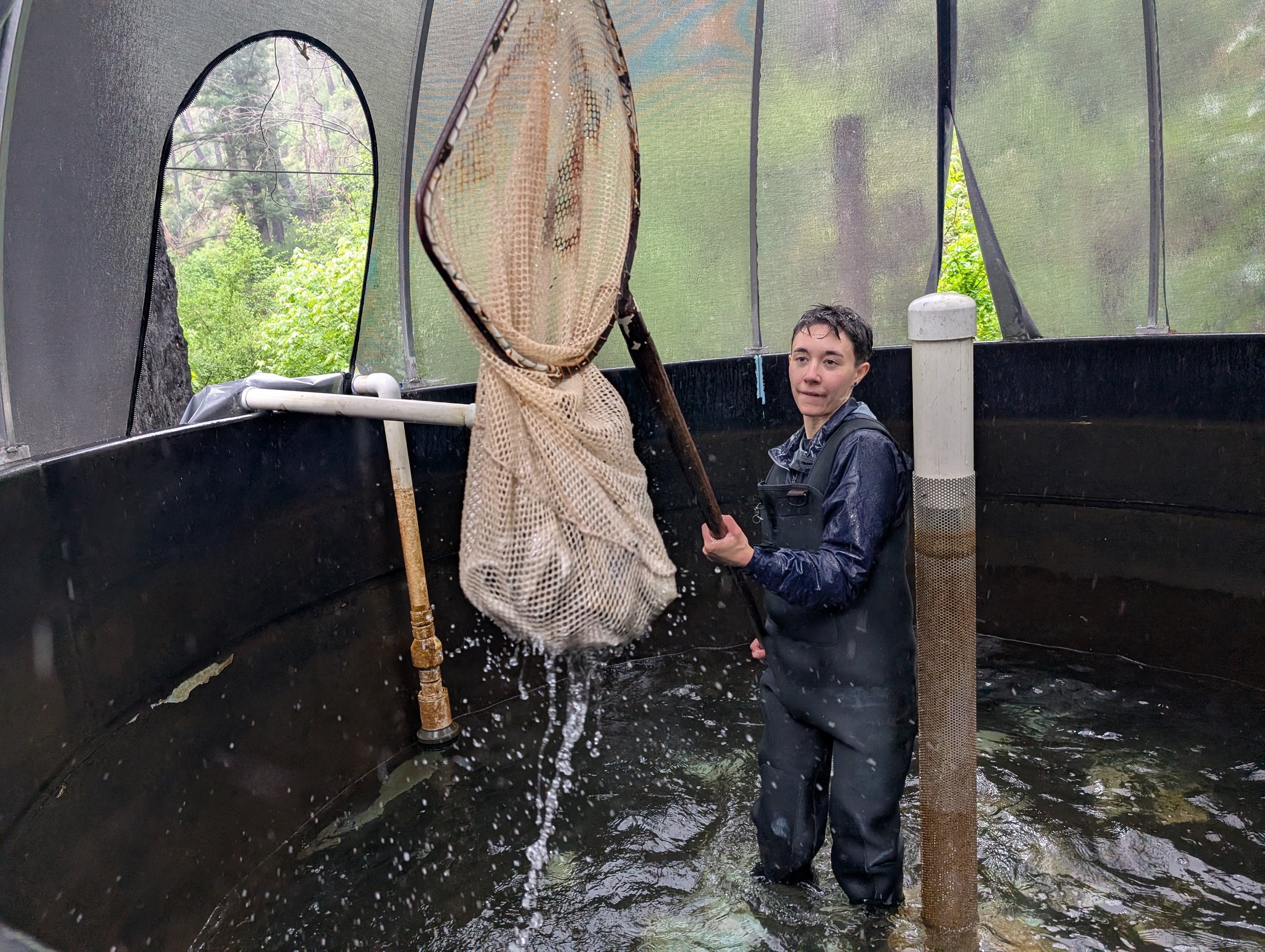
Ultra-focused, he dips a long-handled net into the tank and refills my buckets with coho smolt.
“This is some really manual science,” I say.
“Tell me about it,” he laughs. “I can never really relax until we get them into the creek. That’s really the final step. From there, it’s up to nature.”
Greenwood’s tension is justified. He carries the weight of a species on his shoulders. As manager at MBSTP’s Kingfisher Flat Hatchery, which is located on Big Creek, a tributary of Scott Creek, Greenwood is responsible for the last Central Coast coho south of San Francisco Bay.
MBSTP also supports the recovery of coho’s slightly hardier cousins, the wild steelhead trout, through a rescue and monitoring program, and partners with the California Department of Fish and Wildlife to release 160,000 hatchery-raised chinook salmon from the Santa Cruz Wharf every year.
However, the coho’s dire situation has made it the program’s first priority.
Consider this: In the 1940s, somewhere between 200,000 to 500,000 coho spawned up 50 or more waterways in Santa Cruz and San Mateo counties.
By the 1960s, that number dropped to fewer than 10,000 coho spawning up 11 waterways. In 1995, the annual spawning population of native and naturalized coho salmon was generally restricted to Waddell and Scott Creeks and an estimated 50 to 60 adults.
The following year, they were listed as threatened. In 2006, they landed on the endangered list.
Without the combined efforts of the Salmon Project, NOAA Fisheries and the CDFW, coho south of the Golden Gate would’ve gone extinct and their genetics would have been lost. But this unique species of salmon isn’t out of the woods yet. Not by a long shot.
Coho only live for three years. In general, they spend 9 to 16 months in freshwater, swim out into the ocean for most of their adult lives, and return to their natal streams to spawn and die.
As a result, Greenwood’s team is tasked with rearing, releasing, monitoring, and breeding three-year “classes” of coho at the Kingfisher Flats hatchery.
It’s a delicate, high-maintenance process.
The volunteer-aided rescue push in May took young salmon from the fire-scarred redwoods of the hatchery to the river for a bucket-born release and sprint to the open sea.
Every year, MBSTP workers incubate a new generation of eggs for two months in moist metal closets. Once hatched, they’re moved into 16-foot-long troughs. At this point, they look more like tiny amphibians than fish. They have large, bulging eyes and carry an orange yolk sac attached to their bellies.
Over the course of the next few weeks, they develop into inch-long juveniles and are moved by hand into rearing pools on the hatchery grounds. In preparation for their release into Scott Creek as smolt, they’ll spend a year in these tented tanks swimming against artificial water currents and eating fresh-frozen krill from Antarctica.
Once mature, the fish with the most desirable genetics are set aside and saved to strengthen the species’ overall genetics.
“This kind of program is basically a way to preserve their genetics so they can someday totally repopulate their native habitat,” says Greenwood. “Anything that is sub-optimal, that might not survive in nature, we don’t want to put out on the landscape.”
To complicate matters, Greenwood and his team inject a coded wire tag into the nose of each smolt before its release.
This crude but effective technology gives biologists a rough idea of how many coho survive their years in the ocean. When they return up Scott Creek at the end of their lives, the tags ping a “lifecycle monitoring system” operated by NOAA.
Another 10,000 or so are injected with transponder tags. These tiny, battery-free chips act as a unique ID to provide even more information, including migration tracking and habitat use, as well as return rates.
So what are the return rates for coho? Of the 30,000 smolt released by Greenwood and his team this spring, they expect roughly 200 to 300 fish to survive long enough to return to Scott Creek. “I know it doesn’t sound like it, but those are actually good numbers,” Greenwood says. “We’re happy with that return right now. If we can get that up to 1,300 or so, we can get Central California Coast coho [taken off the endangered list].”
Each stage bringing coho back from the precipice is fraught with peril. Any number of complications can decimate—or even wipe out—the species. In addition to disease and polluted water, coho are threatened by climate-change-driven extremes.
There’s also the possibility of less predictable catastrophe. On August 19, 2020, the CZU August Lightning Fire roared down the steep canyon hillsides around the hatchery, destroying four holding tanks and disrupting water flows to nearby pools stocked with 60,000 salmon fry. Half of the fish suffocated. In addition, chemicals and metals from burning structures seeped into the waterways, contaminating the fish.
“You can see where it burned,” says MBSTP Director Ben Harris, pointing out the scarred trees surrounding the hatchery. “We had to rebuild these four tanks and a bunch of infrastructure like that bridge you crossed to get here.”
Clockwise from top left) hatchery manager Connor Greenwood feeds krill to juvenile salmon; university interns Eleanor Massey and Ava Sabella tend to a tented school of fish before release; Director Ben Harris looks over the tiny smolt tanks with a look that belies his optimism.
Then, between late December 2022 and January 2023, a series of nine intense atmospheric rivers hit Central California. These storms created a 23-day period of near-continuous precipitation—the longest in 70 years of records.
The deluge caused severe flooding and major landslides into Scott Creek and its tributaries, further hampering the coho program’s progress.
While Greenwood and his team labor year-round to ensure that 30,000 of the most genetically diverse coho are released each spring into the waters of Scott Creek, most will die in the ocean, eaten by sea lions, harbor seals, larger fish, and a host of birds, including cormorants, herons and egrets.
In addition, rising ocean temperatures pose a severe threat to coho, a cold-water species, by reducing available food, boosting metabolic stress, and increasing the risk of disease. Despite the challenges, Greenwood remains optimistic.
“It’s a slow process, but we’re making gains,” he says. “The last few years have really felt like wins.”
As the rain continues to fall, I carry two more buckets full of gleaming coho down the wet forest trail to Scott Creek.
As the buckets meet the crystal clear water, the smolt dart into the current, disappear downstream toward the ocean, and I wish them good luck.
Celebrate MBSTP’s 50th anniversary from 5–8pm Saturday, Aug. 1, at the Crosetti Hall on the Watsonville Fairgrounds, 2601 E. Lake Ave., Watsonville. For more information about the event, MBSTP’s programs or becoming a member, visit mbstp.org.
COHO DOWNLOW
A quick primer on a mighty and majestic fish
Despite the fact that coho have declined to 1% of their historic population levels in California, they remain popular in commercial and recreational fisheries in Alaska, the Pacific Northwest and elsewhere in the world.
Coho has a delicate, mild and slightly sweet flavor with a firm, flaky texture. It’s considered less oily and intense than king or sockeye salmon.
Coho were a major part of the Amah Mutsun’s culture and diet for thousands of years. The indigenous peoples of the south-San Francisco and north-Monterey Bay area, also collectively referred to as Ohlone, considered the “silver salmon” a sacred gift.
The Amah Mutsun observed sustainable fishing management practices to ensure strong and healthy coho populations, yet that balance was upended when the human population in the region exploded, particularly in the 20th century.
While there isn’t one factor to blame for coho’s precipitous decline in California, agriculture and early logging practices altered rivers and streams and deforested river banks.
Meanwhile, increased water use for activities like watering lawns lowered river and creek levels.
In 2023, a chemical in car tires called 6PPD-quinone was found to be particularly lethal for the coho of Santa Cruz County. Scientists discovered that levels of 6PPD-quinone were entering rivers and streams as urban runoff during periods of major rainfall. In short, the upstream swim continues.