Skin of the Ocean
Notes from the 2017 Pipeline Bodysurfing Contest
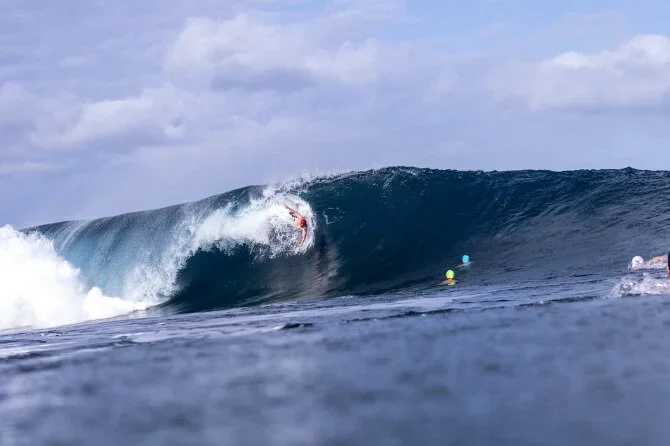
The author on a drainer at the 2017 Pipeline Bodysurfing Contest (Photo: Michael Chlala)
by Ryan Masters, The Surfer’s Journal, 26.5
Roughly 700 voluntary muscles are attached to the bones of the human skeletal system, like the rigging of some wildly complex sailboat. Consequently, bodysurfers don’t ride waves so much as captain flesh and bone. After he won the 2017 Pipeline Bodysurfing Contest in perfect head-to-overhead conditions, Mike Stewart was asked why he devoted so much time to such a practice. He thought for a moment then replied, “Because you are the planing surface. It’s up to you to create the shape.”
There are few waves finer for those shapes than Pipeline. Like Stewart’s Rumi-esque breakdown of bodysurfing, Pipe is equal parts precision and poetry—a perfect complement to the mortal vessel. Event permits at the wave are scarce and notoriously difficult to obtain. This year, the North Shore Lifeguard Association, which took over the bodysurfing contest six years ago, shared its 16-day permit with two, higher priority contests. In previous years, this would have doomed the event to tiny waves or blown-out conditions. Yet 2017 was blessed by an unusually long run of big, late season swell. “I swam out on the morning before the contest,” said event director and North Shore Lifeguard Association President Bryan Phillips. “Second and third reef were breaking with so much energy, it was one of those days where if feels like the beach is shaking.”
The ten, six-man heats were loaded with Hawaii’s finest human foils—guys like Kalani Brown, Sean Enoka, Mel Keawe, Larry Russo, Kai Santos, Todd Sells, Kanealii Wilcox and, of course, Mark Cunningham and Stewart. A handful of talented Californians also made the trip, two of which, Shayne McIntyre and Jeff Mitchell, missed the finals by a handful of points. Many of the local competitors were members of Kaha Nalu Hawaii, a hui of hardcore, bodysurf-centric islanders who have been pushing big-wave boundaries at spots like Waimea and Peahi. “We founded Kaha Nalu Hawaii to perpetuate our heritage and traditions,” said Sean Enoka. “We’ve also made it our mission to travel, to bring Hawaiian bodysurfing to other places.”
It’s important to note that long before a surfboard was built to handle Pipeline, it was bodysurfed. According to the popular narrative, one of three haoles was the first to ride a wave there: Joe Quigg in 1953, the same year he became the first to bodysurf the Wedge; Phillip “Flippy” Hoffman, who allegedly bodysurfed Pipe to win a bet; or Fred Van Dyke, who bodysurfed Nor Cal spots like Steamer Lane and Ghost Tree alone before moving to Hawaii. This, of course, assumes no native Hawaiian swam out and caught a few off Ehukai Beach at any point during the 1,600 or so years preceding 1953—a very large, very cavalier assumption.
Bodysurfing has been a popular practice among Hawaiians of all walks of life for ages, according to BYU-Hawaii professor and surf historian Isaiah Walker. Not just because it’s a low-cost alternative to the increasingly expensive sport of surfing, but because it’s woven into the very fabric of native Hawaiian culture. “What has always fascinated me about bodysurfing,” said Walker, who has judged the Point Panic bodysurfing contest, “is the diversity. Not just racial, but social and economic—from homeless chronics, to television newscasters, to attorneys, to 300-plus pound Hawaiians, to tiny, skinny Asian women, to little kids, to old men. I’ve never seen so much diversity before in the water.”
Stewart and Cunningham predictably placed one and two in the event, followed closely behind by Kai Santos, Bryan Phillips, Todd Sells, and Mel Keawe. Yet every heat felt like a raw display of human shapes embodying ocean waves. At times, the distinction between man and water disappeared altogether. In his poem, “Ocean Birth,” contemporary Māori poet Robert Sullivan writes: “Every wave carries us here—every song to remind us—we are skin of the ocean.” The poem was conceived as sort of a unifying clarion call to all Pacific Islanders. It could just as well have been written for bodysurfers
(Originally appeared in The Surfer’s Journal, 26.5)